Now we’re organized, and have prioritized and planned our tasks. It’s time to do them! Let’s get to work. We don’t need a HOWTO for that, do we? Why is this worth thinking about? Ana calls this “Starting and completing tasks” and OK, sometimes it might be a little tricky to get started. Or to get finished! What might be worth considering? Plenty!
- How we work, focused or multi-tasking.
- What about distractions?
- Procrastination, too! These, and more, can disrupt our best-laid plans. Let’s see, then…
Avoid Multitasking
What is multi-tasking? It’s working on more than one thing at the same time, or working while doing something else. We can do this, right? Homework goes better with some NetFlix in the background. Right??? Nope, sorry. Your brain can’t multi-task. What is happening instead, is task-switching. Your brain switches back and forth from watching Netflix to solving the math problem. That may feel better, but it is inefficient. Work will take longer, and you learn less well. Sure, we can get work done while multi-tasking, but work is easier, faster, and higher-quality when you are focused.
To efficiently get work done, you should plan to work on it without also doing something else. Focus on completing on task at a time for better results.
Distraction
Let’s clarify, then, what we mean by “one task at a time.” In order to focus, you identify and eliminate factors that disrupt your focus. These factors include clutter, other people, and notifications. Your computer and phone are full of distractions, aren’t they? That makes it tricky when you are trying to work on your computer or phone.
One way to focus is to go somewhere. Being isolated is a good way to avoid the “other people” distraction. Folks have found success by going to the library, or a coffee shop, or an office. Headphones are helpful here. Is music a distraction? Sometimes, sure. But maybe you can find some music which is not. Classical or Lofi might be a good choice. Something you are singing along to is probably not.
And then there’s the matter of notifications. After all, we might miss something important, like a funny cat meme. We don’t want to be disconnected from our social circles. One solution is to work in blocks. For example, commit to focusing for 50 minutes followed by a 10 minute break where you can re-engage society, or whatever else give you a break. 50 minutes too much? Try half. 25-minutes is an established technique: Pomodoro 🍅 If you don’t have a tomato-timer, you can set your phone on airplane mode and use the countdown timer.
It feels like we can multi-task, and that work is less onerous if we do it while partially distracted. For busywork, when time permits, that’s a fine way to work. There will come times, if they haven’t already, where you need to focus to improve the efficiency and quality of your work (think: an exam!) so practicing working with focus is a worthwhile skill to develop.
Here’s a graph, from The Teenage Brain, by Dr. Jensen.
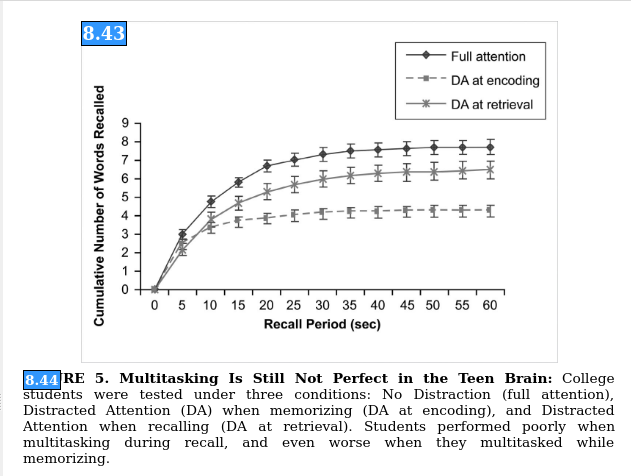
You can totally do work while distracted, you’ll just be less efficient. Plan accordingly.
Procrastination and Motivation
Sometimes we just don’t feel like working. Maybe we don’t feel like working at all, or maybe we don’t feel like working on a specific task. Other times, work can be engaging, if not outright fun. What’s going on here?
Well, there are many reasons we might feel like procrastinating, from anxiety and overwhelm to a lack of inspiration (“hmm, what should I write about?)” or task aversion (“I hate civics!”). One reason worth investigating, is motivation. What is the reason for this task? And it that reason good enough?
There are various theories of motivation (wow, many!) but the one that makes sense to me (and I didn’t actually read any of those in that last link) is Autonomy, Mastery, and Purpose (AMP) from the book Drive by Daniel Pink. I like it because it offers psychological tools that we can use to maybe influence our motivation.
- Autonomy means how much control we have over our task. Rarely do we want to do something because somebody told us to. We are much happier to do something we chose to do. And sure, maybe we choose to do fun stuff, while others ask us to do non-fun stuff, but the extent to which we can take control of our work (maybe “how” if not “what”) will improve our willingness to do it.
- Mastery means how well we are able to do it. It’s not much fun to try to do something you don’t know how! Learning (gaining mastery) is motivating, if it is working. But if you get stuck… “hmm, what else could I be doing instead?” On the flip side, tasks that are “too easy” quickly become boring. The sweet spot seems to be slightly above our comfort level: things that are a bit challenging, but not too difficult.
- Purpose answers the “why am I doing this?” question. Some answers (“because it was assigned”) aren’t very good, but if you can look for a better answer, maybe something that aligns with a deeper purpose, then your willingness to do the work tends to increase, sometimes dramatically. There is a spectrum of answers: “because I’ll be rewarded” (a grade, 💰️, etc.) may be somewhat motivating, but finding alignment with your goals or another higher purpose is the winning angle, here.
Note that you can influence those. You can take a different perspective to increase autonomy and purpose, and learn or practice to increase mastery. Or if you can’t, maybe this isn’t a good task for you. Can you do the minimum to get it done?
Just Do It
You know how to do stuff. The thoughts above might make it easier, as will organizing and planning. What did you do today? How did that go? Take stock of that, and maybe feed “what worked” and “what didn’t” back into your next round of planning.
A last tip is to keep track of what you did. Maybe start a habit of recording your accomplishments at the end of the day. If you have to write down “this is what I accomplished today” your ego will be happier when you accomplished stuff, then when you have nothing. Today on my list is “Dad on Doing.” ✔️